
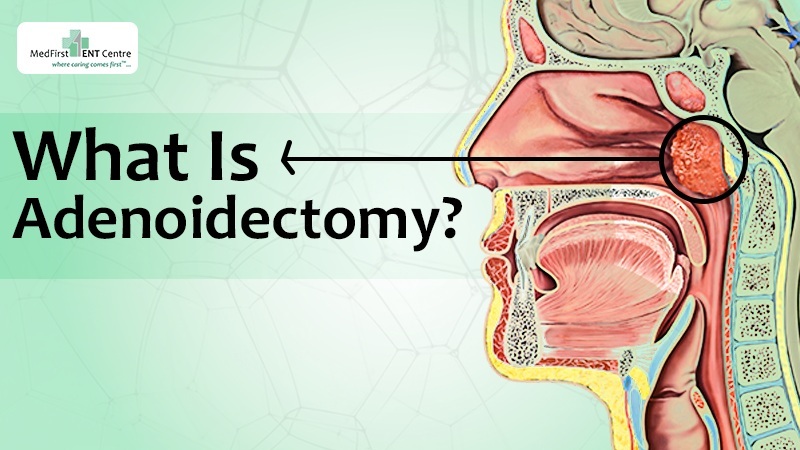
Adenoids are small lymphoid aggregations in the back of a child’s nose in an area called the Nasopharynx
They grow from age 2 onwards and persist till the child’s immune system matures, usually by adolescence – sometimes they persist up to adult years as well.
Enlarged Adenoids cause many symptoms and these are related to the Anatomical location of the Adenoids.
Problems Associated with enlarged Adenoids
- NASAL BLOCKAGE
Nasal blockage because they lie at the back of the nose
- EAR SYMPTOMS
Ear pain, ear blockage, eardrum retraction, impaired hearing
- DENTAL
Dental malocclusion, crowding of upper incisors, maldevelopment of the Maxilla
‘Adenoid Facies’. Due to absence of nasal breathing – nasal breathing creates positive pressure to push the palate down- due to enlarged Adenoids there is no nasal breathing and the palate remains high and narrow.
- SLEEP DISORDERED BREATHING (SDB)/ OBSTRUCTIVE SLEEP APNOEA
Daytime sleepiness
Bed wetting
Cognitive Deficit
- Learning, memory, and visuospatial skills
- Language, verbal fluency, and phonological skills
- Concept formation, analytic thinking, and verbal and nonverbal comprehension
- School performance and mathematical abilities
- Executive functions
Behavioural Abnormalities
- Hyperactivity, Attention deficit/ hyperactivity disorder (ADHD)
- hypersomnolence, somatization, depression, atypicality,
- aggression, and abnormal social behaviours
Craniofacial Abnormalities
- 60% of facial growth is attained by 6 years and about 90% by 11–12 years of age
- Abnormal nasal resistance early in life leads to mouth breathing associated with abnormal muscle tone, oral-facial hypotonia, and secondary changes in maxillary-mandibular growth
Obesity
- Overweight/obesity was associated with an increased prevalence of snoring
If you suspect that your child has an enlarged Adenoid you should visit your ENT Specialist for discussion and treatment
AT The ENT Clinic
The ENT Surgeon will examine the Nose and the Throat (Tonsils are quite often also enlarged in a child with Adenoid enlargement)
Patency of the nasal airway will be checked
If the child is cooperative a nasal endoscopy may be carried out
If required, some simple radiological investigation like an X Ray or CBCT (Cone Beam computed Tomography) may be advised – CBCT claims much lower radiation exposure – equivalent to a simple X ray but gives much more information.
Decision To Operate
Once a decision has been taken to operate – mutually between the caregivers and the ENT Surgeon some simple preoperative tests are ordered. These may be –
CBC, Sugar (r), Viral marker studies, Urine R/E or some other test as seems required before the surgery.
Modalities including filling out the preauthorization form and other formalities are completed.
Pre Operative Instruction
The child will be a minimum of 6 hours fasting (nothing to eat or drink) before the surgery. This is done to prevent food particles/ water from regurgitating from the stomach into the lungs during the anaesthesia.
The child should wear loose clothing without any metal or buttons as far as possible.
It is recommended that only the primary caregivers accompany the child – avoid overcrowding the medical facility with family members. Keep other children at home.
Keep the child motivated and encouraged
Following The Surgery
Once the child has gone into the OT it will take at least an hour (usually more) before the child will come to the recovery room. This is because apart from the surgery, induction of General Anaesthesia and recovery from the Anaesthesia also takes time.
Once the child comes to the recovery room following the surgery one parent should stay with the child for offering comfort. Avoid stimulating the child since the effect of the Anaesthesia has not yet worn off completely and the child will be a bit sedated.
Adenoid surgery is a day care surgery and the child is usually sent to the comfort of the home the same day.
What Are the Complications Associated with An Adenoidectomy?
Compared to Tonsillectomy Adenoid removal is associated with minimal complications.
These may be
- VPI – Velo pharyngeal insufficiency- manifest as hyper nasal speech and nasal regurgitation
- Eustachian Tube orifice scarring
- Nasopharyngeal stenosis – narrowing of the area behind the nose due to scarring and fibrosis
- Post operative bleeding in a few cases where post nasal packing may be required
FAQs
- Can Adenoids regrow after the surgery?
Adenoids are not encapsulated – they are pieces of loose tissue so complete removal is never possible. As per international statistics regrowth can occur from 1 to 9 % cases and re-surgery may be required in up to 3 % of cases
- Will my child’s OSA (Obstructive Sleep Apnoea) disappear after the surgery?
In most instances the child will breathe and sleep much better after the surgery.
Optimal results are obtained if the surgery is done soon after nasal blockage and SDB is reported. If operated after 7 years of age the results are not as good.
Some children may still need a CPAP machine- specially in cases where Tonsils are enlarged and not removed and in cases of Obesity or other medical issues including cranio- facial abnormalities.
- Will my child’s mouth breathing stop immediately after the surgery?
This will depend on many factors including for how long the child has been a mouth- breather plus the presence of other contributory causes of nasal blockage including a nasal septal deviation and others.
Some children may need Myo-Functional Therapy after the surgery to promote nasal breathing.